
What 257km Through the Sahara Taught Me About the Mental Game

Marathon des Sables 2016 — 6 days, 55°C, and the most honest conversation I've ever had with myself.
I waited about a week after coming home before writing this. I needed the dust to settle — literally and figuratively. I was sleeping a lot, had zero motivation to train, and my body was quietly asking me to leave it alone. All good signs, apparently.
So. The Marathon des Sables. 257km through the southern Moroccan Sahara. You carry your own food for 6 days in a backpack, receive a daily water ration, sleep in an open Berber tent with strangers, and run through temperatures between 35 and 55°C with humidity so low your nose and throat protest the entire time.
They say "just making it to the start line is a major achievement." I heard that before the race. By the end, I understood exactly why.
We were four Romanians — myself, Ela, Andrei and Daniel. One team, one goal, and enough dark humour to get through anything.
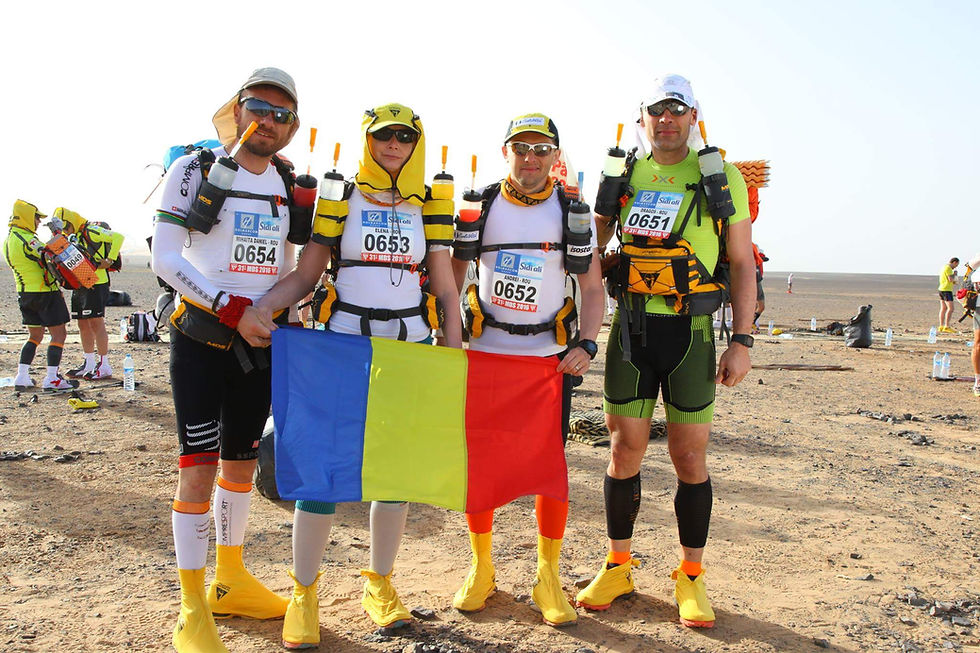
Here's what those seven days in the desert genuinely taught me about mental performance.
Lesson 1: Your body quits at 50%. Your mind decides everything after that.
Day 4. The long stage. 85km. We set off at 8am and I crossed the finish line at 5:30 the following morning — 21 and a half hours later.
By hour 15, I was somewhere between exhaustion and hallucination. I spotted a scorpion in the middle of the trail and started poking it with my foot. Not my finest moment. The lights of the bivouac appeared in the distance and seemed to float there, never getting closer, for what felt like an eternity.
Here's the thing I came to understand during that stage — a thought that has stayed with me ever since:
When you feel completely finished, you're probably at around 40-50% of your actual limit.
The body has a sophisticated self-protection system. It sends signals — pain, fatigue, the overwhelming urge to stop — long before you're truly done. These signals are not the truth. They're a negotiation.
What gets you from 50% to 80% is not fitness. It's the decision to keep moving anyway. And what gets you from 80% to the end — where things start to genuinely break down — is something harder to train and easier to ignore: psychological resilience.
Forth day - The old man in the tent behind ours had packed up his race gear at 6am, two hours before the long stage start. He went from tent to tent, shaking everyone's hand. Smiling sadly. He was withdrawing before the hardest stage. I never found out what had broken him. But I've thought about him many times since. Because that's the real race — the one nobody sees, the one happening entirely inside your own head.
Lesson 2: Your support system is part of your race strategy — not a luxury.
Every afternoon around 4-5pm, a volunteer would bring printed messages from family and friends to each tent. Letters that had been sent through the race website, addressed to your competitor number. I was number 651.
I read them. I re-read them. Sometimes with tears running down a face that hadn't seen soap in four days.
What struck me wasn't the sentiment — it was the effect. Every time I read one of those messages, something shifted. Not emotionally, but functionally. I ran differently the next morning. Made different decisions at checkpoints. Pushed through moments I might otherwise have let beat me.
I also knew Alina — my wife — was to travel to the desert to run the final charity stage with me. That knowledge sat in my chest for the entire race like a small engine. An anchor point. Something real to move toward.
This is one of the most underestimated elements of extreme endurance preparation. Athletes spend hundreds of hours on physical training and almost no time thinking about the human infrastructure around their race — who knows what you're doing, who is holding space for you, what you're running toward beyond the finish line.
In my 8-week coaching programme, we map this deliberately. Not because it's nice to have. Because on kilometre 70 of a long stage, at 2am, with blisters down to the bone, it may be the only thing that keeps you moving.
Lesson 3: The finish line is rarely where you think it is.
On Day 6 — the last stage — something strange happened at the finish line. The organisers had decided to give out the medals the following day, at the end of the charity stage, to ensure everyone completed it.
But mentally, we had already finished.
There were tears anyway. The kind that come not from joy exactly, but from relief.
Six days of accumulated pressure, fear, pain, doubt and determination — all of it leaving the body at once.
The charity stage felt like a formality. I walked most of it with Alina. We talked for nine kilometres straight. When Patrick Bauer — the race director — placed the medal around my neck, I expected a flood of emotion. Instead, I felt strangely calm.
The real finish line had been 24 hours earlier.
This is something I've seen consistently in athletes going into extreme races: they focus almost entirely on the physical crossing of the finish line. But the psychological finish line — the moment the mind truly lets go of the outcome — often arrives at a completely different time. Sometimes early. Sometimes much later than expected. And if you haven't prepared for that gap, it can be deeply disorienting.
Knowing where your finish line actually is — what you're really racing toward, what completing this means to you beyond the medal — is one of the first things we explore together in Life Game Coaching.

A final thought.
The Maraton des Sables is not, ultimately, a running race. It's a multi-day negotiation between who you think you are and who you actually are when everything is stripped away.
The sand doesn't care about your training plan. The heat doesn't care about your preparation. What carries you through is something older and less measurable — clarity of purpose, mental toughness built over time, and the honest knowledge of why you're there in the first place.
That's what I coach. Not motivation. Not tactics. The deep game.
If you're preparing for Marathon des Sables, Norseman, Celtman, Swissman, or Icon — or any race that asks everything of you — and you feel like the mental side of your preparation is lagging behind your legs, I'd love to talk to you.



Comments